Why the Prompt Book Became a Production Memory
A prompt book gives an amateur theatre production a shared record of cues and decisions, helping cast and crew preserve continuity when people or plans change.
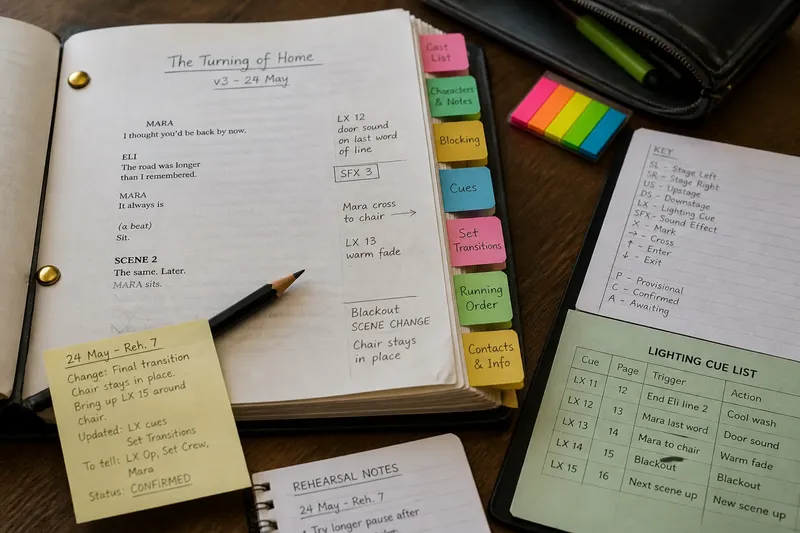
Why does a production need a prompt book if everyone remembers what happened at rehearsal? Because a show changes between rehearsals: a cue is adjusted, an entrance shifts, or an actor misses a call. The prompt book gives an amateur theatre production a shared record of those decisions, so the next person can pick up the work without relying on one person’s memory.
Consider an invented situation at a small community theatre. The stage manager, Leila, has been keeping notes in a script folder, but the lighting operator has a separate cue list and the director’s blocking changes live on loose paper. When Leila is away for a rehearsal, the cast can run the scenes, but no one is sure which version of a transition is current. The difficulty is not that the company lacks commitment; it is that its knowledge is scattered.
Leila’s response is to turn one working copy of the script into the production’s prompt book. She brings the latest script, a pencil, sticky tabs and a folder for supporting documents. The aim is not to preserve every conversation. It is to make the decisions that affect the performance easy to find, understand and update.
A prompt book records what the company has decided
A prompt book is the stage manager’s working record of the performance. It commonly includes the script marked with cues and movement, alongside practical notes and documents needed to run the show. In an amateur company, it may be a bound script, a ring binder or a carefully organised digital file. Its format matters less than having one agreed place where the current version can be checked.
It is useful to distinguish a record from a transcript. The prompt book need not capture every suggestion made in the room. It should capture what the team has settled on, what remains provisional and what another person needs to know to carry out the decision. A note such as “door sound here” may be too vague. “Door sound on Mara’s final word; operator takes cue from the prompt” gives the operator and the person calling the show a clearer reference.
Leila starts by writing the production title and version date on the script cover. She keeps the approved script text intact and makes blocking notes in the margins, using a small key for abbreviations. A separate sheet explains those marks, so a substitute stage manager does not have to guess what “X” or an arrow means. A new change is pencilled in until the director confirms it; then Leila updates the working record and removes any superseded instruction.
Keep performance cues distinct from rehearsal reminders
A cue is a signal for an action to happen: for example, a lighting change, a sound effect, a shift of scenery or the start of an entrance. The prompt book needs to show the cue point and the action clearly enough for the person calling or operating it. A rehearsal reminder has a different purpose. “Try a longer pause” may help an actor explore a moment, but it does not belong beside a final cue unless the director has made that pause part of the settled timing.
Leila separates these kinds of information. In the script margin, she marks the agreed cue point and names the cue in language that matches the operator’s list. On a rehearsal page, she records an open question: the pause is still being explored. Once the director decides, Leila updates the script and tells the relevant operator. This prevents a provisional idea from quietly becoming an instruction simply because it was written down.
For movement, concise landmarks are often more useful than a detailed account of every gesture. Leila notes that Mara enters from stage left, crosses to the chair after a particular line and leaves through the upstage door at the scene break. She does not try to record the actor’s breath or every hand movement. The note preserves the pattern that supports entrances, exits and technical timing while leaving room for the actor’s performance to stay alive.
Make changes traceable without making the book cumbersome
During the invented production’s next rehearsal, the director changes the final transition. Instead of moving the chair during a blackout, the company will leave it in place and bring up the next scene’s lights around it. Leila writes the change in the prompt book, notes who needs to know and updates the lighting and set-transition documents. She also removes the old instruction from the active pages, rather than leaving two plausible versions side by side.
This is where the prompt book becomes production memory rather than a private notebook. A change usually touches more than one person: the actor who moves the chair, the crew member who handles it, the lighting operator who cues the scene and the stage manager who calls the sequence. The record should make those connections visible. A short note can say which related document was updated or which person still needs confirmation.
To keep the record readable, Leila uses a consistent approach:
- Write the date or rehearsal identifier beside a new decision.
- Mark whether it is confirmed, provisional or still awaiting an answer.
- Use the same cue names in the script and the operator’s cue list.
- Remove or clearly cross out instructions that no longer apply.
- Tell the people affected by a change rather than assuming they will read the book.
- Keep backup material, such as contact details or scene schedules, in a clearly labelled section.
These habits do not create extra paperwork for its own sake. They help the company distinguish the current plan from the path it took to reach it. The record can stay brief if it captures the decision, its status and its practical consequences.
What should a prompt book preserve?
Who needs access to the prompt book?
The stage manager usually maintains the working copy, while the director, deputy stage manager or relevant operators may need access to particular information. Agree who can edit the master and how approved changes are shared, so people are not working from competing versions.
Should every rehearsal note go into the book?
No. Keep observations that support continuity, cueing or an agreed performance choice, and leave exploratory suggestions in rehearsal notes until they are settled. This makes the prompt book easier to scan when the company needs an instruction quickly.
Can a digital file replace a paper script?
It can, if the company can reliably access the file and identify the current version during rehearsals and performances. A paper copy may be simpler in some rooms; a digital record can be easier to update and share. Choose a format that the people responsible for running the show can actually use.
What belongs in a substitute stage manager’s handover?
Include the current script and cue sequence, the meanings of any shorthand, unresolved questions and the names or roles of people who operate key elements. Also point out unusual timings or transitions that are easy to miss, rather than expecting a substitute to infer them from the pages.
A handover shows whether the record works
Leila tests the book’s usefulness in the invented situation by asking another company member to follow the transition notes while she watches. The stand-in can identify the chair’s position, the lighting cue and the point at which the next scene begins. One note is still unclear, so Leila rewrites it in plain language and checks the related cue list. The observable result is a handover that no longer depends on Leila explaining each decision from memory.
This is a practical standard for a prompt book: someone familiar with theatre but new to this particular production should be able to locate the current instruction and understand what to do with it. The book cannot replace a briefing or a conversation, especially where timing and coordination matter. It can, however, give that conversation a reliable starting point and preserve what was agreed afterwards.
For an amateur theatre production, the prompt book’s value is not measured by its thickness. Its value lies in whether it keeps shared decisions usable as people come and go, scenes settle and cues are refined. Start with the information that affects the next rehearsal, make ownership clear, and keep the record aligned with what the company has actually agreed. When a new person can follow the show’s logic without needing its history retold, the production has turned memory into something the whole team can use.